
Bird Netting & Structural Exclusion
Engineered Protection | Building-Safe Installation
New York City & Long Island
Bird Netting Installation New York City & Long Island Structural Protection Guaranteed
We are The Ex-Terminators, your reliable ally for state-of-the-art bird netting solutions in New York, covering NYC, Queens, Brooklyn, the Bronx, Staten Island, and Long Island. Our specialized services are crafted to tackle the distinctive challenges presented by bird control in these lively and diverse environments.
WHY PIGEONS INFEST STRUCTURES
- Roosting Shelf Preference: Pigeons instinctively seek flat, elevated ledges that simulate their natural cliffside nesting environments. Architectural projections such as cornices, beams, signage bands, and balcony slabs provide perfect man-made substitutes for these natural habitats.
- Site Fidelity & Habit Formation: Once pigeons establish a roosting or nesting location, they demonstrate strong site loyalty. Birds will return daily — and often generationally — to the same structure unless physically prevented from doing so.
- Predator & Weather Shielding: Urban structures provide overhead protection from predators and harsh weather. Covered loading docks, air shafts, awnings, and mechanical recesses create safe harbor zones where birds can remain undisturbed.
- Thermal & Environmental Attraction: Buildings emit heat through mechanical systems, ventilation exhaust, and structural mass. These warmer microclimates attract pigeons, particularly in colder seasons, reinforcing structural nesting behavior.
- Nesting Stability: Structural voids allow pigeons to build nests that are shielded from wind and human disruption. Over time, nesting material, feathers, and droppings accumulate — creating unsanitary and corrosive conditions.
- Urban Food Proximity: Restaurants, waste areas, sidewalks, and loading zones provide consistent feeding opportunities. Birds will roost as close as possible to reliable food sources, increasing infestation pressure on surrounding structures.
HOW BIRD NETTING EXCLUSION WORKS
- Physical Space Denial: Bird netting works by removing the single factor pigeons require to inhabit a structure — physical access. Unlike deterrents that attempt to repel birds, netting eliminates the ability to land, roost, or nest entirely.
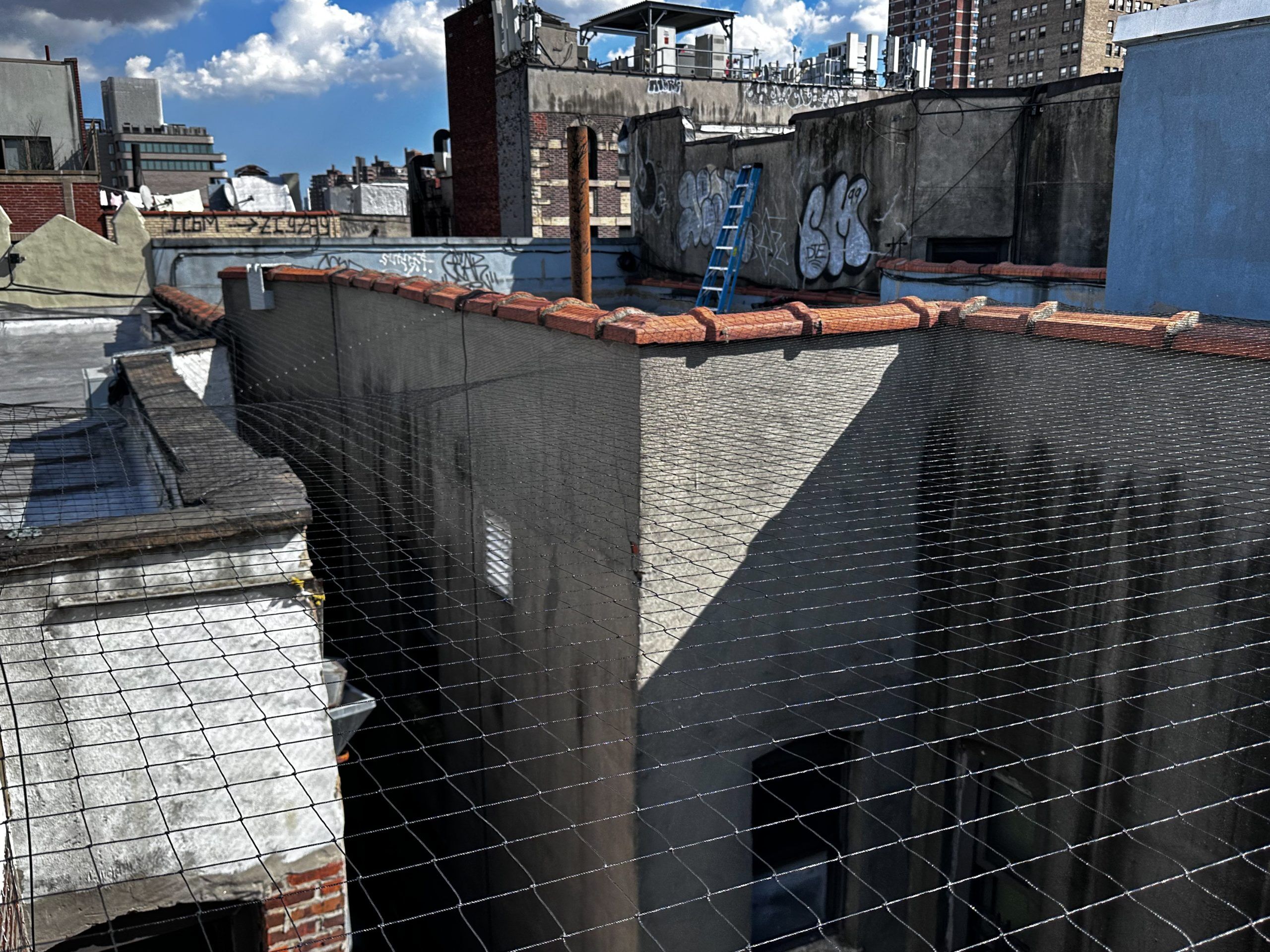
- Containment Barrier Engineering: Netting systems are installed as tensioned containment barriers that seal off architectural voids, ledges, and structural cavities. Once enclosed, the environment becomes inaccessible to bird activity.
- Behavioral Interruption: When pigeons cannot physically access a habitual roosting site, the behavioral cycle is broken. Birds are forced to relocate rather than adapt, as netting provides no landing tolerance.
- Non-Lethal, Humane Control: Exclusion netting controls bird populations without harm. By denying space rather than inflicting injury, netting aligns with humane wildlife management practices and regulatory compliance.
- Long-Term Structural Protection: Properly installed netting prevents droppings accumulation, nesting debris, parasite harborage, and uric acid corrosion — protecting both building surfaces and occupant health.
- Discreet Architectural Integration: Modern netting systems are engineered for minimal visibility while maintaining full exclusion performance. Mesh size, color, and tensioning are selected to blend with the structure while delivering permanent protection.
WHERE BIRD NETTING DELIVERS THE GREATEST VALUE
Bird netting exclusion systems provide the greatest benefit in environments where structural bird activity creates health risks, property damage, operational disruption, or regulatory exposure. In dense urban markets such as New York City, pigeons exploit architectural complexity — establishing roosting and nesting zones across residential, commercial, and industrial structures.
Property managers, building owners, co-op boards, facility engineers, and commercial operators deploy bird netting to eliminate persistent infestations while protecting both physical infrastructure and occupant environments. Exclusion systems are particularly valuable in locations where sanitation, safety, and public perception directly impact operations.
- Residential Buildings: Balconies, terraces, façades, and shared air shafts where nesting debris and droppings create health concerns for occupants.
- Commercial Properties: Storefronts, signage bands, and customer walkways where unsanitary conditions impact business visibility and pedestrian experience.
- Industrial Facilities: Warehouses, loading docks, and manufacturing plants where bird contamination threatens inventory, equipment, and compliance standards.
- Institutional Structures: Schools, hospitals, and government buildings where bird activity presents heightened sanitation and liability exposure.
- Parking Structures & Transit Zones: Garages, depots, and transportation hubs where droppings accumulation accelerates structural corrosion and maintenance costs.
For these stakeholders, bird netting is not a cosmetic upgrade — it is a structural risk mitigation system designed to protect assets, preserve sanitation standards, and restore safe, usable environments. When properly engineered and installed, exclusion netting transforms bird-prone structures into permanently protected zones.
Bird Netting Exclusion
Key Considerations
FREQUENTLY ASKED QUESTIONS
What is bird netting exclusion? Bird netting exclusion is a structural bird control method that prevents pigeons and other pest birds from accessing architectural spaces where they roost, nest, or congregate. By physically sealing off these environments, netting eliminates the conditions required for long-term bird habitation as part of a broader New York Bird Control Services strategy.
Why choose bird netting over deterrents like spikes or gel? Deterrents attempt to discourage birds from landing, but they do not eliminate access to the environment itself. Bird netting provides full containment exclusion — preventing landing, roosting, and nesting entirely — which delivers longer-term structural protection. In severe infestation environments, exclusion may be paired with population reduction measures such as Pigeon Trapping Services.
Where can bird netting be installed? Bird netting can be deployed across a broad range of structural environments where pigeons establish roosting and nesting pressure, including balconies, air shafts, light wells, loading docks, storefront awnings, warehouse ceiling voids, parking structures, mechanical equipment zones, and decorative façade elements such as cornices, ornamental entry door hoods, and architectural canopy voids.
Is bird netting humane? Yes. Bird netting is considered one of the most humane forms of bird control because it prevents access rather than causing harm. Birds are excluded from the space without injury and are forced to relocate to alternative environments.
Is bird netting visible once installed? Professionally installed bird netting systems are engineered for minimal visual impact. Proper mesh sizing, perimeter tensioning, and structural integration ensure the system remains discreet while maintaining full exclusion performance.
How is bird netting actually installed? Bird netting systems are installed as engineered containment barriers designed to fully seal off bird-prone structural environments. Installation begins with the placement of mechanical anchor points into appropriate structural substrates such as brick, concrete, steel, stone, or wood. A stainless-steel or galvanized perimeter cable framework is then installed and tensioned to create a stable structural support system. The netting — often deployed in single continuous spans where site geometry permits — is secured to the cable framework and tensioned to eliminate sag, landing tolerance, or entry gaps.
Does installation require drilling into the building? Yes. Most bird netting installations require mechanical anchoring into structural substrates such as brick, concrete, limestone, steel, or wood framing. Anchoring points are selected carefully to ensure structural stability while maintaining building integrity.
Will drilling damage the structure or cause leaks? When performed correctly, drilling for bird netting installation does not compromise the building envelope. Anchors are placed in appropriate substrates, sealed as needed, and installed in a manner that prevents water intrusion, masonry spalling, or structural weakening.
How do technicians access bird netting installation areas? Access methods are determined by building height, structural configuration, and installation location. Depending on site conditions, bird netting systems may be installed using scissor lifts, boom lifts (MEWPs), bosun’s chairs, rope-access systems, ladders, or rooftop deployment techniques. Each method is selected to provide safe, controlled access to elevated or confined work zones such as façades, shafts, canopies, loading docks, and mechanical structures while maintaining installation precision and occupant safety.
Can bird netting be installed on occupied properties? Yes. Most bird netting installations are performed on active residential, commercial, and industrial properties. Systems are engineered to maintain access, visibility, and operational functionality while eliminating bird activity.
What makes a bird netting system durable in New York City conditions? Durability is driven by material selection and installation method. UV-stabilized polyethylene mesh, stainless-steel cable frameworks, and corrosion-resistant fasteners are used to withstand prolonged sun exposure, wind loads, precipitation, and seasonal temperature cycling common in NYC.
What materials are used in professional bird netting systems? Commercial-grade bird netting systems typically incorporate UV-treated mesh, stainless-steel perimeter cabling, compression sleeves, turnbuckles, and structural anchors designed to maintain tension integrity and long-term exclusion performance.
What does “sealed exclusion” mean? Sealed exclusion refers to the complete containment of a bird-prone environment. All perimeter gaps, returns, corners, and structural transitions are enclosed to eliminate landing tolerance and nesting voids. Partial coverage or open-edge installations can allow birds to bypass the system.
How long does bird netting last? Professionally installed bird netting systems are designed for long-term performance. UV-stabilized mesh, stainless-steel cabling, and corrosion-resistant hardware allow systems to withstand weather exposure and environmental stress for many years.
Does bird netting require maintenance? While bird netting is designed as a long-term exclusion solution, periodic inspection is recommended to ensure tension integrity, hardware stability, and continued performance — particularly in high-exposure urban environments.
Does bird netting require maintenance after installation? While netting is engineered as a long-term exclusion solution, periodic inspection is recommended to confirm tension stability, hardware integrity, and system performance — particularly following façade work, construction activity, or severe weather exposure.

Partner with
certified
professionals
in
Humane Bird Control
Elevate your bird control strategy with our locally informed, aesthetically integrated, and highly effective Bird Netting solutions. Contact us today for a consultation and experience the difference in bird control for New York City and Long Island.
Licensed • Insured • Bird Control Specialists
Structural bird abatement and pest control services serving New York City and Long Island.